Thứ Bảy, 13 tháng 11, 2010

The Lake Palace on Lake Pichola

UDAIPUR'S TAJ LAKE PALACE IN INDIA, A ROMANTIC TRYST FOR A PRINCE

Resembling a Venetian palace and built entirely of marble, this stark white confection of cupolas, tranquil gardens with lily ponds, fountains and sprays of crimson Bougainvillea occupies a four acre rock in the middle of Lake Pichola.

Built in 1746 as a venue for Udaipur’s royal prince Maharana Jagat Singh II to entertain his paramours, the Lake Palace to this day, weaves a spell of enchantment around all who visit .

A night view from the Lake Palace across Lake Pichola
Like another world, part of its charm for us was that it was cut off from the bustle of city life just a ten minute boat ride away. We were blessedly free from the roar of car and bus engines. There were no pigs foraging in garbage at the roadside, no sacred cows lying in the middle of the road disrupting the traffic.

As I sat at the window of our suite the ancient chant of a muezzin calling the faithful to prayer and the passionate, tremulous notes of an Indian gazal drifted across the water. Close-by a grey cormorant perched on the bow of a fishing boat with wings spread wide to catch cool breezes, whilst clumps of water hyacinth splashed with blue swayed sensuously at each passing of the water taxi.

Bougainvillea
 Life was not always as tranquil in the Palace, though. There was a time during the rule of the British Raj when tensions ran high between the British authorities and the head of India’s premier royal family. Called upon to enlist men for the British army during the First World War, Maharana Fateh Singh, a feisty old fellow, exerted his royal privilege and declined. To him the British rulers were upstarts. Nevertheless, after the war he was awarded a military medal which he brushed aside with a disdainful “Put it on my horse. This is the sort of thing my messengers wear”.

Illustrious guests visit the Lake Palace
Since those days relations with Britain have improved. In 1961 Queen Elizabeth II and Prince Philip were guests of the Maharana. The following year Jacqueline Kennedy and her sister, Princess Lee Radziwell were entertained at the palace. To this day Udaipur’s water palace remains a venue for royalty and the distinguished. The Shah or Iran, the Queen of the Netherlands, His Majesty Shri Wangchuck, Prince of Bhutan and his Queen are just a few of its royal visitors.

Posted by Anne Gordon on Saturday, 13th November, 2010
Lake Palace interior
THE TAJ LAKE PALACE'S  ELEGANT  DECOR

True to its majestic past the suites and public rooms of the Taj Lake Palace are decorated with opulent Asian elegance.

Furniture is inlaid with ivory, deeply cushioned, or carved from dark and heavy Indian wood. Brass lanterns sway at the end of long chains and glints of reflected sunlight from myriads of stained glass windows shimmer like tiny coloured jewels on marble floors.

Jharokhas (arched windows with carved marble screens) through which royal women in purdah were able to unobtrusively view life on the outside are a feature in many of the rooms. In the centre of the Khush Mahal Suite, once the private domain of the Maharani, an antique jhoola swings gently from ornamental chains.

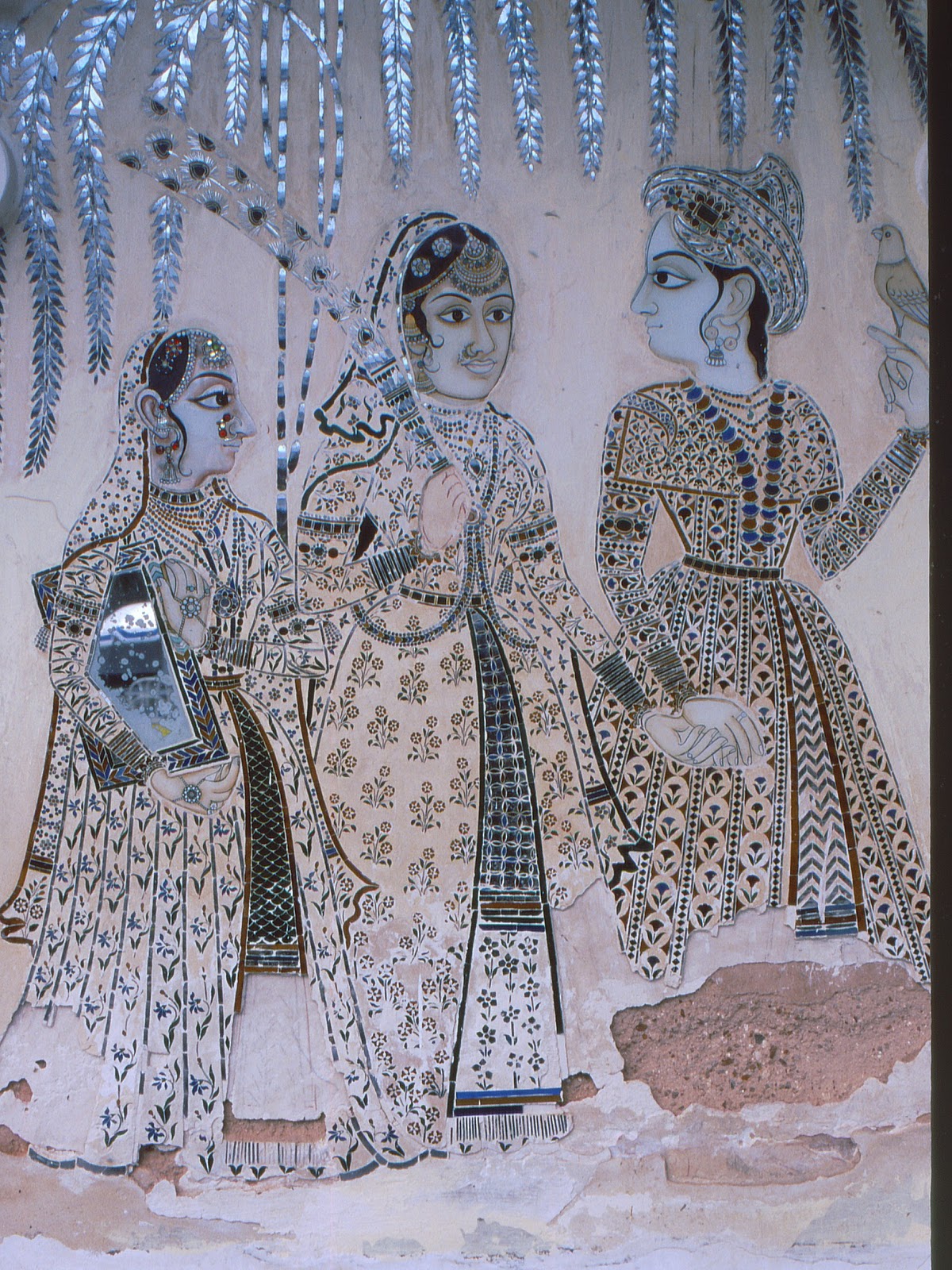
The swimming pool too, was an inviting diversion. Sheltered by arches supporting heavy sprays of flowering Bouganvillea, and walls embedded with delicate mirrored and silvered flowers and fruits tipped with coloured enamel, guests lounged on patio chairs. As we swam in the late afternoon a flock of long-tailed green parakeets swooped down over our heads to land, en masse, in the branches of a mango tree beside the pool.

Ornamented wall beside swimming pool
Looking across the waters to Udaipur it was hard to believe that in rare dry years Lake Pichola is sometimes completely devoid of water. Then it is possible to walk across the exposed lake bed to Jag Mander, another of Udaipur’s lake palaces. Be warned though – there can be unexpected traffic. The current Maharana and owner of the Lake Palace has been known to drive his Rolls Royce across the parched sediment when visiting his property.

Dining at the Lake Palace is a sumptuous affair. ‘Fleet your time carelessly, undisturbed except for the flutter caused by cool breeze’ was the quaint but inviting description for dinner on the patio. Guests can also enjoy a romantic dinner on the Gangaur boat. Lit by hundreds of candles the antique royal barge cruises the lake rowed by a dashing crew in colourful Rajasthani dress.

At the Neel Kamal Restaurant we sampled Indian cuisine – vegetarian Palak Paneer, a mouth-watering blend of cottage cheese and spinach in a spicy sauce.

Posted by Anne Gordon on Saturday, 13th November, 2010

Thứ Sáu, 12 tháng 11, 2010

Trinity College Library, Dublin

WIN A VACATION TO IRELAND

Win a Vacation to Ireland through Tourism Ireland’s New Facebook Page


Tourism Ireland is giving Canadians a chance to win the vacation of a lifetime to Ireland through the launch of its new Facebook Fan Page DiscoverIrelandCA.

Signing Belfast's Peace Wall
Canadians can join in the ‘craic’ (Irish for ‘good fun’) by becoming a fan. Tourism Ireland encourages fans to upload and share their experiences and photos of Ireland. They can also engage in discussions with other fans, view videos of Ireland’s many locals, and see what festivals and events are listed for 2011! One thing’s certain – Ireland’s Facebook page will be fun and interactive.

Follow Tourism Ireland on Facebook at DiscoverIrelandCA and Twitter at GoToIrelandCA.


See www.discoverireland.com for more information on travel in the Island of Ireland. You can also call 1 800 SHAMROCK or email info.ca@tourismireland.com.

Posted by Anne Gordon on Friday, 12th November, 2010.

Thứ Tư, 10 tháng 11, 2010

TRAVEL TIPS
Travel insurance - don't leave home without it.  It could turn out to be the most expensive mistake you ever make.

Thứ Hai, 8 tháng 11, 2010


Swan on her nest at Abbotsbury Swannery

ABBOTSBURY SWANNERY, ONCE A DEN OF INIQUITY

In the 1700s the Journal of London pronounced “all the people of Abbotsbury – including the vicar – thieves, smugglers and plunderers of wrecks”.

Over the centuries much has changed. Abbotsbury is now a quaint, but respectable village; its showpiece, a 14th century swannery, home to a huge colony of birds that have lived and procreated on Dorset's Jurassic coast for hundreds of years.

Child feeding the swans at Abbotsbury Swannery
Once serving as a larder and a source of culinary delicacies for the monks of the Benedictine monastery of St. Peters in the village, the swans now provide the feathers that decorate the helmets of the ‘Gentlemen at Arms’, the Queen's traditional bodyguard.

Loath to give way to modernity, Lloyds of London, the world's most renowned insurance underwriter, uses swan quills from Abbotsbury to record in their 'Doom Book', the dark days when the company settles insurance claims

More to follow on Abbotsbury's Swannery ...

Posted by Anne Gordon on Monday, 8th November, 2010
Waimea Canyon

 NATURE IN ALL ITS GLORY IN KAUAI'S STATE PARKS

There are numerous ways to tour Kauai, but for a bird’s eye view, soaring aloft in a helicopter alongside albatrosses and Nenes (Hawaii’s national bird), and viewing the massive fluted NaPali cliffs and the canyon in miniature from the vault of an endless sky has been described as a spiritual experience.

For those with budgetary constraints, Koke’e State Park, the Waimea Canyon and the Alakei Swamp are easily accessible by car. Just a short drive to the end of the trail, and NaPali’s magnificent cliffs and a turquoise ocean, home to pregnant humpback whales in the spring, are clearly visible from Kalalau Lookout and Pu’u o Kila Lookout.

Dancers performing the hula
Kauai's Kee Beach hula dance school
Near Kee Beach at the foot of the cliffs, the remains of an ancient heiau (hula dance school) draws hula enthusiasts from around the world. They come to honour Laka and to dance on sacred ground.

In times past novice students at this same heiau were closely guarded and compelled to abide by a stringent set of rules. Certain foods were prohibited. Cleanliness was mandatory. Contact with the dead was off limits and sex was forbidden.

A certain danger was also involved. At the culmination of their course, students were required to swim across a lagoon, home to a giant shark. Woe betide any who had broken even one of the taboos. Punishment was death by mauling.

Waimea Canyon, Kauai's 'Jewel in the Crown'
For Kaui’s most impressive vista, Waimea Canyon is undoubtedly the island’s ‘jewel in the crown’. Plunging 1,158 metres at its deepest point and spreading for close to 22 kilometres, Mark Twain’s ‘Grand Canyon of the Pacific’ is a favourite with hikers.

Small in comparison with its cousin in Arizona, the canyon’s earthy tones; emerald fading to pale green, rust, yellow ochre, light to dark chocolate and the saturated rose tints of its volcanic rock buttresses dazzled my eyes. Cliffs and peaks with waterfalls tumbling from unimagineable heights after rain, is a magnificent sight. As I leaned against the safety railing at Pu’u Ka Pele Lookout, I couldn’t help gasping at the glorious manifestation of nature’s majesty.

Polynesian royalty at Waimea Canyon
A Polynesian royal ceremony in progress
Wandering down to an open space away from the Lookout, I came upon a ceremony featuring visiting Polynesian Kings, Queens and Chiefs from the 15 Kingdoms and tribes of the Polynesian Triangle.

Like Birds of Paradise, elaborately and gorgeously attired in colourful apparel, these delegates - in Kauai to attend a conference in the small coastal town of Waimea - looked the epitome of Polynesian royalty. Standing on the sidelines, onlookers watched respectfully silent as the royal participants, led by a Polynesian man, almost naked but clothed elaborately in tattoes from the top of his head to the soles of his feet, offered prayers to their deities.

A Kauai sunset
Late that afternoon as we headed on down to the coast and the Waimea Plantation cottages where we were to spend the night, I couldn’t help thinking of the astronauts. Out there in space among the stars they must have looked down on the island as the last light of day slipped away like a ghost and Kauai welcomed the night.

Posted by Anne Gordon on Monday, 8th November, 2010
Hawaiian night

BEAUTIFUL KAUAI, ONE OF THE SMALLEST OF THE POPULAR HAWAIIAN ISLANDS

Kauai may be one of the smallest of the popular Hawaiian islands but it is the oldest and undoubtedly one of the most beautiful.

The first in a chain of volcanic islands destined to emerge over millennia, it has for centuries drawn to its shores Polynesian adventurers, settlers from every continent searching for a better life, missionaries intent upon conversion, and in their multitudes tourists and travelers in pursuit of the ultimate destination. One of the latter, I was lured by the island’s stunning natural grandeur and the culture of a people who had courageously set out from the Marquesas long long ago in a quest for a land unknown.

Nathan Aweau, Songwriter and performer
Unlike its sister islands where glitz and glamour prevail, Kauai has retained its old world charm. For that reason Hawaiians from neighbouring islands; Oahu, Maui, Molokai, Lanai and the Big Island, choose Kauai over all others as their own holiday destination. Tourism as we know it has yet to make a significant impact on the island, even though the spirit of aloha lies deep within the souls of its people.For me, Kauai’s natural treasure lies to the west in the Koke’e and Waimea Canyon State Parks. Its mysterious fluted NaPali cliffs and the Alakei Swamp on a 30 square mile lava plateau are closeby. These areas encapsulate nature’s stunning vistas and fascination with dramatic flare.

Alakei is the world’s highest swamp at an elevation of 1,599 metres. Mist is more-or-less a constant in this mysterious environment. It drifts over moss-covered rocks and trees and clings like a ghostly cloud along the edges of a wooden boardwalk where violets and lush tropical ferns grow in rampant splendour.

Each year this strange but fascinating place almost disappears under a deluge of hundreds of inches of rain. In 1871 Hawaii’s Queen Emma was not daunted by Alakei’s inhospitable terrain. The Queen and her entourage including 100 hula dancers undertook to cross the swamp en route to the other side of the island. Today’s boardwalk was still a project of the future and the royal party undoubtedly sank up to their knees in the cloying red mud.

In Koke’e and the Waimea Canyon, rainbows, dense swirling mists, gentle rain showers and brilliant sunshine are the norm, but reaching those deliciously cool 60-degree temperatures in the mountains involves negotiating a road with potholes large enough to swallow a prize winning pumpkin.

In Koke’e’s vast rainforest (home to the hoary bat, Kauai’s only native land mammal) foreign tree species including redwoods and Japanese sugi cedars, mingle with native plants. Other foreign imports include dogs, chickens, rats and most importantly pigs brought in by Polynesians when they colonized the island. Wild boar from Europe have interbred with local pigs producing a vigorous strain and together with mule deer and black-tailed deer the local hunters are assured of lively sport.

Hawaiian leis
Prolific bird life on Kauai
Although birds are prolific on Kauai, many native birds, including the ‘o’o ‘a’a, are now extinct. In the past Hawaiians applied a sticky substance to tree branches, then, with offerings of fruit tempted the birds to alight. Once captured, a small number of yellow feathers from the ‘o’o ‘a’a and the red feathers of the ‘i’wi and ‘apapane were plucked from the captive birds and used for making cloaks for festive occasions. After parting with their feathers, the birds were released. The red feathered ‘i’wi and ‘apapane can still be seen in the rainforest.

Local Kauaians frequently visit the rainforest because of its connections with Laka the Goddess of hula. It is here that they collect the greenery of the mokihana and maile plants for making fragrant leis as decoration for two of the most sacred hula altars in Polynesia.

Posted by Anne Gordon on Monday, 8th November, 2010