Thứ Sáu, 31 tháng 12, 2010

Mexicans celebrate

      HAPPY NEW YEAR TO ALL MY READERS
                   FROM ANNE GORDON
            'WORLD TRAVEL WITH ANNE'
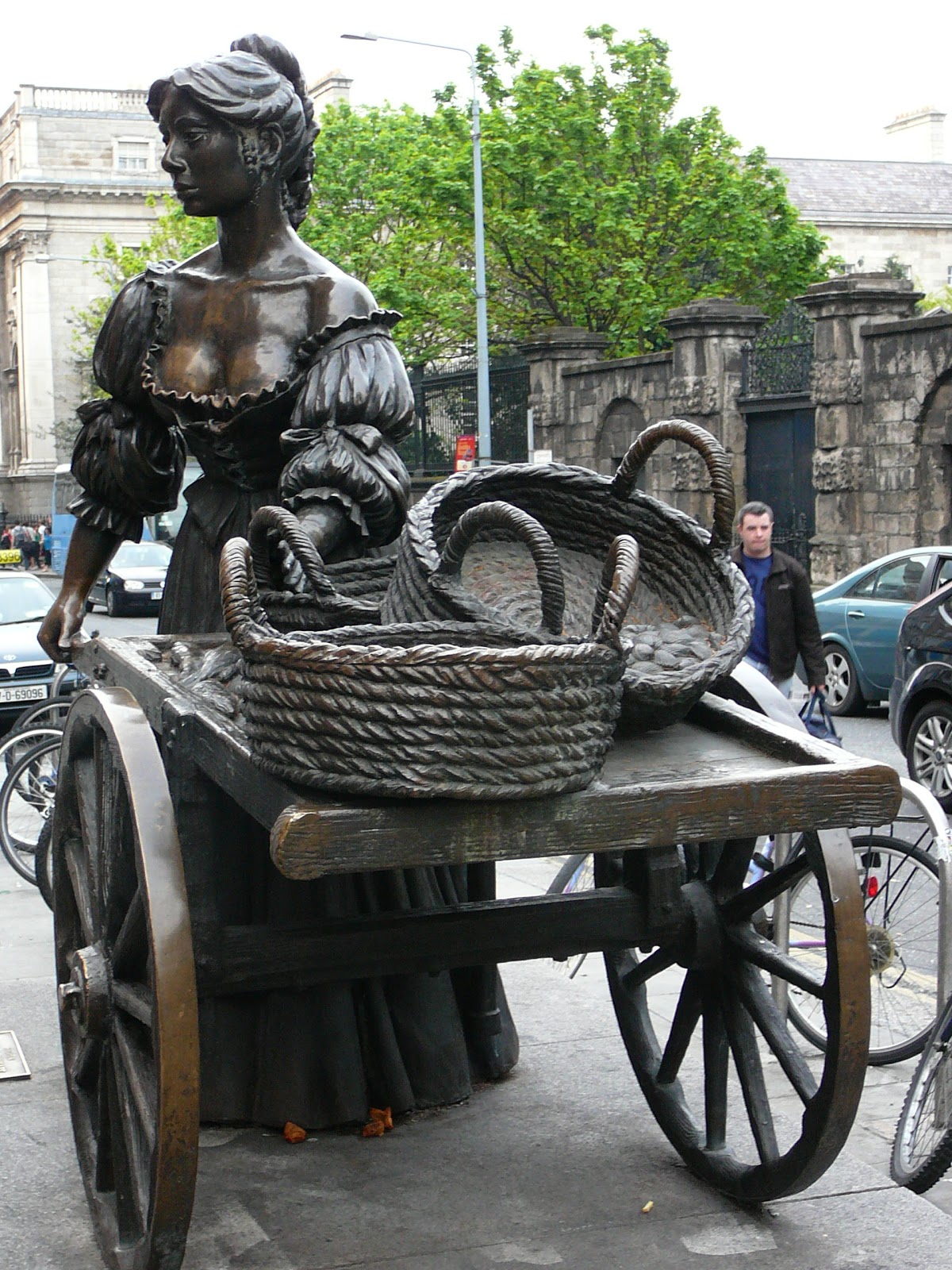
Dublin's Sweet Molly Malone - 'The Dish with the Fish'

EVER WITTY, EVER IRREVERENT, THE IRISH HAVE THEIR OWN NAMES FOR DUBLIN'S STATUES

“In Dublin's fair city, where girls are so pretty

I first set my eyes on sweet Molly Malone,

She wheeled a wheelbarrow, through streets broad and narrow

Crying cockles and mussels al-live, a-live oh.”

To visit Dublin and not see its statues would be for more than one reason, a regrettable mistake. The Irish in their inimitable witty and irreverent way have given nicknames to just about every statue and memorial in the city.

Replacing O'Connell Street's 'Nelson's Pillar' that was blown up by the IRA in 1966, is a tall needle-like structure that attracts huge attention. Waxing lyrical as only an Irishman can, its epithets include 'The Spike', 'The Stiletto in the Ghetto', 'The Stiffey at the Liffey', 'The Erection in the Intersection', 'The Nail in the Pale' and the 'Binge Syringe'.

A jaunty James Joyce wielding a cane as he stands cross-legged on a plinth in Dublin is a well-known Irish writer.  His statue on North Earl Street, is known as 'The Prick with a Stick'.

On Grafton Street visitors can make the aquaintance of Molly Malone, a comely young fishmonger whose story is told in Dublin's famous anthem of the same name. Molly, like the 'The Spire of Dublin', enjoys a litany of appelations: the 'Tart with the Cart', the 'Trollop with the Scallops', 'Flirt in the Skirt', the 'Dish with the Fish' and the 'Dolly with the Trolley'.

Queen Victoria's statue that now stands in pride of place outside the Queen Victoria Building in Sydney, Australia, was named 'Auld Bitch' by none other than James Joyce who now has his own nickname as mentioned earlier.

When crossing Dublin's famous Ha'penny Bridge, there is a statue of two women chatting with their shopping at their feet. They're known as the 'Hags with the Bags'.

Photo copyright Anne Gordon

Posted by Anne Gordon on Friday, 31st December, 2010

Thứ Năm, 30 tháng 12, 2010


One of a cluster of Remarkable Rocks on Kangaroo Island


AUSTRALIA'S "REMARKABLE ROCKS" IN FLINDERS NATIONAL PARK ON KANGAROO ISLAND
One of the major attractions in Flinder’s National Park on Kangaroo Island off the coast of Australia are the  “Remarkable Rocks". 

 These massive granite boulders sculpted over millennia by wind and weather are balanced on a smooth 75 metre high rocky cliff that plunges straight to the sea.

An Aboriginal legend 
A local story relates how 3000 years ago the entire Aboriginal population of the island committed mass suicide from these same rocks.  Because of this event and others of a spiritual nature, mainland Aborigines call Kangaroo Island  ‘Karta, Land of the Dead’.  Under no condition will they venture anywhere near it.

There is abundant wildlife to see in this area including kangaroos, koalas, seals at Seal Bay and Cape Barren Geese.

Photos copyright Anne Gordon

Posted by Anne Gordon on Thursday, 30th December, 2010

Thứ Hai, 27 tháng 12, 2010

Quebec's Ice Hotel

A NIGHT IN CANADA'S ICE HOTEL, "THE HOTEL DE GLACE", AN EXPERIENCE LIKE NO OTHER

Canada's Ice Hotel just seven minutes from downtown Quebec city, looms like an exotic igloo in a world of snow and ice.

Proving to be a popular venue on Quebec's tourist circuit in Canada, North America's only ice hotel, open for business from January 7th to March 27th, ensures a winter experience unlike any other. Since its inception in 2001, over half a million visitors have marvelled at a structure built of 15,000 tons of snow and 500 tons of ice.  Each year the hotel is re-built, each year the decor is different.

Quebec's palace of ice
Powdered with snowflakes drifting from a sky that melds absolutely with a pristine earth, it is like another world. Inside, sculpted ice pillars give it the appearance of a palace for a snow queen. Artworks abound: ice sculptures, intricate ice carvings on the walls, ornate alcoves and a massive ice chandelier that changes colour continuously.

At the ABSOLUT Ice Bar, guests clad in furs, ski jackets, toques, gloves, boots and thick socks, puff clouds of vapor each time they speak. Vodka served in ice glasses is the drink of choice, but for a unique Absolut experience order a 'Sensual Confusion' (Absolut vanilla, orange juice and grenadine) or an 'Earth Juice' (Absolut lemon, curacao and lime juice).

Sadly for light-fingered wayfarers though, absconding with a souvenir glass will bring but brief pleasure. The slightest rise in temperature, and the souvenir, like a face of wax in front of a warming fire, is soon just a puddle.

Canada's ice hotel for a most unusual "I do"
There is a thriving business here for unusual marriage ceremonies in a chapel with low, skin -covered ice pews. A stained glass window in a stark white setting is a foil for a transparent ice altar set back in an arched alcove. When the chill becomes excessive, the marriage officer has been known to wear a fur musquash hat.

The dragon bed in the Ice Hotel's Chinese suite
Along frosty passageways with subdued lighting, doors lead into bedrooms where everything including the beds are ice – some elaborately ornate. My favourite when I visited was the Chinese suite where a double bed rested in the icy coils of a dragon. A creature of fire, the dragon's head reared above plumped pillows with its fire-blowing mouth belching forth icy flames into a hole in the ceiling.

Prior to a night in this wintry B&B, a romantic soak in the hot tub under a starry Quebec sky (or maybe a gentle snowfall) does act as a warm-up. From there guests are advised to strip down to the barest minimum, envelop themselves in a giant shawl and wriggle into a sub-arctic sleeping bag. Trussed like mummies in the tombs of ancient Egypt, hardy visitors then settle for the night on beds of ice, covered with animal skins.

With such an elaborate getting-ready-for-bed ritual it would be foolhardy to drink anything for at least a couple of hours before retiring (and this may be difficult if you have spent the evening at the bar). Exiting your cosy cocoon, then having to dress completely for a visit to the 'facilities' (not ice), is certain to intrude rudely upon your sleep.

Those less adventurous will be pleased to hear that a room at the nearby Four Points by Sheraton is part of the Ice Hotel deal. Guests have the option of enduring the 4 am chill to reach a conventional bed in the Sheraton.

Photos copyright Anne Gordon

Posted by Anne Gordon on Monday, 27th December, 2010


DOG SLEDDING IN CANADA'S WORLD OF HUSKIES AND MALAMUTES

In a world of drifting snow I was greeted by a noisy mix of Malamutes and Huskies at a sled site outside of Quebec city.  Already in harness, the excited dogs awaited 'wannabe' mushers and sledders.

Before boarding my flimsy transport I was drawn to the pen housing progeny of the trained working dogs. The puppies were fat roly-poly bundles of creamy fur . Wriggling with delight,  they licked and nuzzled at any face that came within tongue's reach.

Given basic instruction by a guide at Aventure Inukshuk on how to handle the sled, our tour group were then warned that if the musher for any reason abandoned the sled, nothing would stop the dogs.

The guide, it seemed, delighted most in instructing his apprehensive first-timers on how to vacate the sled should the musher fall from his or her post and leave us – the out of control sled riders - to the energetic machinations of six trained-to-pull Huskies!!

Ready to go, my travel companion Melissa acting as musher stood with one foot on the skate the other on the brake. I was ensconced on a damp black cushion and covered waist to toe with a gray blanket dappled with fast melting snowflakes. All about me ice crystals danced in the air and the excited dogs yelped, barked and keened.

The head musher and leader balanced on the back of his sled, raised his arm alerting us to take-off,  then suddenly he surged forward. Following behind, each sled in turn shot like an arrow from a bow and we slipped with effortless speed onto the narrow trail, into the still white forest.

Snow-laden fir branches, drooping like weary dancers, brushed against us as we rushed by. Feathery snowflakes, as if from a burst pillow, drifted down and settled on my face. The trail ahead twisted and turned, a sleek icy ribbon through an avenue of conifers.

Most of the dogs quietened, although our back pair, especially the female, was vocal still. Her bark was high, penetrating, bordering on hysteria. Maybe her role was that of a 'cheerleader', in a canine way encouraging the others to further exert themselves.

Each of our six dogs it seemed, had their own distinctive style. The first two, the leaders, were excited. When we stopped for a moment the dog on the right somehow managed to maneuver himself, in spite of being harnessed, onto the far side of the left dog. He lifted his leg and did a quick pee on the snow bank, trailing a steaming shaky golden dribble for a meter or so.

The middle two seemed the more sensible of the team. Heads bowed, bodies tense, they were ready to go when signaled, and they ran straight and true.

The back two, the strongest, and to my eyes the most comical had very definite traits. “Right” had a heavy rear end and his run bordered on a waddle. “Left's hind quarters tended towards the snow bank while her head kept towards the middle. She ran a crab-like course, moving forward with determined vigor but in a slight sideways motion. Yelping hysterically she became particularly vociferous when we stopped. Then, with an appetite for snow that would freeze a human's innards, she gulped mouthfuls as if it were some delicious doggy treat.

The males in the different teams were involved in intermittent confrontations. Like their testosterone-laden human counterparts they seemed ever-ready for a skirmish.

Each time we paused at least one of the dogs rolled over in a mound of snow, legs extended skyward, heavily furred back squirming vigorously in a canine version of 'snow angels'. This was their world – below freezing temperatures, snow and ice, running and pulling. .

As we raced through the forest the sled in front of ours slid sideways into a slow collapse. The passenger tumbled from the lopsided seat. For a moment the acting musher took her foot from the brake and the team bounded away with the abandoned pair in hot pursuit.

Our four mile adventure ended all too soon. The memory of that still white forest, the hiss of the sled's skates on packed snow and the impatient yodeling of Huskies – these sounds will forever remind me of Quebec and the pleasures of a Canadian winter.

Photos copyright Anne Gordon

Posted by Anne Gordon on Monday, 27th December, 2010
Chủ Nhật, 26 tháng 12, 2010

Our group ready to descend into the Bultfontein Diamond Mine in Kimberley

THE KIMBERLEY DIAMOND MINE IN SOUTH AFRICA IS NOT FOR THE CLAUSTROPHOBIC

It was in the Bultfontein Mine with a group of others, that I made a jaw-dropping descent for 3 ½ minutes into absolute darkness.  We were entombed in a small Otis elevator like so many sardines in a can.

Our transport rattled alarmingly as we dropped to the 825 metre level. Equipped with a lamp, dressed in blue overalls, and wearing a white helmet, I had a Cesar Hoya (“Help me to breath”) contraption strapped to my waist. The Cesar Hoya was guaranteed to give me 45 minutes of oxygen should I need it!

As rock rushed past us and we plummeted deep into the earth, my imagination kicked into high gear at the thought of getting ever closer to a sea of molten lava.

Exiting the elevator, we made our way along rock tunnels guided by a red line. It is easy to lose one's sense of direction underground we were told. As we walked, the massive boom of explosions echoed through the caves. The air seemed heavier and much hotter as we moved further into the mine.

A 'Refuge Chamber' where people could come for food supplies, first aid and fresh air should there be a collapse loomed up beside us. Need I say I was pleased to see it.  Up to 50 miners could survive for up to a week in this chamber with its separate air system. My fast beating heart slowed somewhat when I heard that it had yet to be used.

When we reached the rockface where mining was underway, a film of dust blanketed everything, wire netting was nailed overhead to close off caverns containing the diamond bearing kimberlite pipes. I was sweating in my overalls and on looking up into the darkness from our eerily lit cave, I saw a man standing high above us watching. Why was he there I wondered.  Why was he watching.  It was creepy.

This is a tough if profitable industry. It takes 10 ½ tons of rock to yield only a handful of diamonds and these would sell for between $1,000 a carat to $100,000 a carat, depending on the quality of the gem. In this same mine, the largest diamond ever found – a 616 carat yellow diamond – was discovered by a native miner. For his discovery he received the maximum reward of $10,000 and a home for his family.

South Africa is still the top producer of quality diamonds in the world and De Beers has absolute control of the world's diamond marketing. Australia's Argyle Mine is the largest producer of diamonds, but 98% of their diamonds are industrial stones.

While listening to the tour guide's story about South Africa's diamonds - as fascinating as it was - I decided that this would be my last ever descent into a mine.  And then suddenly, in this intimidating, foreign environment, where to be quite honest I felt an oppressive fear, I heard the melodious tones of an African miner singing.  Deep in the bowels of the earth his beautiful voice echoing along rock passages, imprinted on my mind an experiences that not only soothed me at that moment, but will live with me forever.

Photos copyright Anne Gordon

Posted by Anne Gordon on Sunday, 26th December, 2010
http://www.sa-v
Kimberley's Big Hole Diamond Mine

KIMBERLEY'S 'BIG HOLE' IN THE DIAMOND-STUDDED MANTLE OF AFRICA.


If you travel to Kimberley you can't help but see The Big Hole. It is a great black pit that cuts through the rocky diamond-studded mantle of Africa. The Big Hole at 215 metres deep is the largest man made hole in existence.

The first diamond discovered in South Africa in 1869 was found in the walls of a farmhouse in nearby Bultfontein. Needless to say the house soon bit the dust and the diamond rush was on. Just over a year later, diamonds were discovered in what is now Kimberley and the excavation of the Big Hole was underway.


A representation of all the diamonds mined from the Big Hole during its lifetime
 At times there were 30,000 men working in the Kimberley Mine, each with a small staked out claim linked to the surface by a spider web of cables and ropes. As the hole got deeper the conditions became more chaotic. It seemed that there was a limitless supply of diamonds. Affluent diamond-diggers in a flamboyant display of wealth lit their cigars with bank notes and their lady friends bathed in champagne and enjoyed the pleasures of wealth. Today travel to Kimberley is an experience in historical and mineral exploration combined.

Photos copyright Anne Gordon

Posted by Anne Gordon on Sunday, 26th December, 2010